

There are various types of breast implants available in the UK. The types can be categorised by the material inside the breast implant, the breast implant’s shape or profile, and the outer texture of the breast implant.
Modern silicone implants are the most common type of breast implant used for breast enlargement in the UK due to their natural look and feel, while traditional saline-filled implants are now rarely used.
Breast implant shape, filling material and surface texture can all affect the appearance, movement, and long-term safety of your results.
In this guide, Consultant Breast Surgeon Mr Andrew Pieri explains the different types of breast implants available, including the pros, cons, risks, and which options may suit different patients best.
Types of Breast Implants Compared
Implant Type | Feel | Appearance | Most Common Use | Main Downsides |
Silicone implants |
Soft and natural |
Natural movement |
Most UK breast augmentations |
Requires surgery if rupture occurs |
Saline implants |
Firmer |
Less natural |
Rarely used in UK |
More prone to rippling |
Gummy bear implants |
Firm but stable |
Structured shape |
Some reconstruction or anatomical cases |
Slightly firmer feel |
Round implants |
Fuller upper breast |
Enhanced cleavage |
Most cosmetic augmentations |
Less subtle in some cases |
Teardrop implants |
Sloped/natural |
Subtle contour |
Select reconstruction cases |
Risk of rotation |
Materials Used For Breast Implants
The material used to make your breast implants is the primary consideration you need to think about because the material affects the results of your breast implant surgery significantly. Many women choose silicone implants, but saline breast implants can work for some patients. Saline implants are rarely used in the UK.
Silicone Breast Implants
Silicone implants are a modern type of breast implant comprising a silicone shell filled with silicone gel. This choice is popular with many women because they are comfortable and can give a natural look and feel.
These implants are less prone to rippling than saline breast implants and fit comfortably into the breast implant pocket.
Gummy Bear Breast Implants
Silicone implants have a highly cohesive silicone gel filling, which are also known as ‘gummy bear breast implants’ or ‘form stable implants’. As the names suggest, gummy bear implants have a stable gel consistency such that, if you were to cut an implant in half, the gel would not leak out like a liquid but would hold its form to some extent, like a gummy bear.
Because the silicone gel is more cohesive, gummy bear breast implants are designed to maintain their shape even if the implant shell is damaged. This can reduce silicone migration and may help maintain a stable breast shape over time.
Saline Breast Implants
Saline implants consist of a silicone shell filled with sterile salt water. They tend to look and feel firmer than natural breast tissue.
While these traditional breast implants are now one of the least common breast implant options, saline breast implants do offer some benefits, especially when it comes to scar tissue.
Because saline implants are inserted empty and then filled when inside the breast, they require smaller incisions, as opposed to silicone implants, which require a slightly longer incision.
Also, if implant rupture occurs, it is easily noticed with saline breast implants, as opposed to silicone implants, and the saline can be absorbed into the body and the shell removed surgically. If a silicone implant ruptures, the gel filling and the implant shell have to be removed surgically, which can cause further scarring.
Breast Implant Surface Texture
Some silicone implants have a grippy surface, known as “macro-textured” implants. The main purpose of macro-texture is to grip the breast tissue and help reduce implant rotation. For this reason, it is more commonly used in anatomical AKA teardrop implants as rotation is a significant problem with this shape, whereas implant rotation doesn’t really matter with symmetrical round breast implants. The main issue with macro-textured implants is that they have been associated with a higher risk of anaplastic large cell lymphoma (ALCL).
Most modern implants now have a less grippy surface texture (to reduce or negate ALCL risk mainly) and are categorised as micro-textured, nano-textured or smooth, depending on the amount of texturing applied to the implant surface.
There are many pros and cons to the various implant surface texture options. It is important to ask your surgeon to explain their preference and reasoning for this, based on the current research evidence. At the time of writing, Mr Pieri mainly uses nano-textured surface implants, such as Motiva Ergonomix or GC Aesthetics Perle. This is due to the low ALCL rates, low capsular contracture rates and more natural look and feel they often achieve.
Breast Implant Shapes
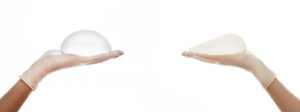
The shape of your breast implants also has an impact on the results you get from your breast implant procedure, but the two shapes offered are similar to each other.
Round Breast Implants
Round implants are a popular choice for many women. Because they offer an even shape, these implants will provide fullness in the whole breast. Some round implants are designed to provide a firmer projected cleavage and pronounced depth. Others are designed to have a softer gel fill, which gives a much more natural result, historically associated more with anatomical implants.
Teardrop Breast Implants
Teardrop shape implants used to be a better option for women wanting to achieve a more natural result. However, this can be equally achieved with some types of modern round implants, without the downsides of teardrop implants (higher ALCL risk if macro-textured or rotation risks if not macro-textured). Anatomical implants are still used by some surgeons, but they are not as widely used since more natural round implant options have been introduced to the market.
What Are The Best Types Of Breast Implants For Your Breast Augmentation?
The best breast implant for you depends on several factors, including:
- whether you are having cosmetic or reconstructive surgery
- your natural breast tissue
- chest shape and frame
- desired breast size
- whether you want a subtle or fuller result
- lifestyle and activity levels
Choosing to undergo a breast augmentation or another surgical procedure involving breast implants, such as breast asymmetry or breast reconstruction following a breast cancer diagnosis and a mastectomy, is a major decision, and there are many small selections you need to make.
To help you find the right implant type for your breast implant procedure, you need to work with an experienced breast surgeon.
Mr Pieri has extensive experience carrying out breast augmentation surgery in Newcastle and the North East, so he can provide you with the support you need.
From the beginning, he offers extensive support to his patients, providing a breast implant sizing session to help them find the right size and type of breast implant.
Factors such as implant width, projection, gel cohesiveness, tissue characteristics, and chest proportions all influence the final result.
At consultation, Mr Pieri takes time to discuss:
- your goals and expectations
- implant feel and movement
- long-term considerations
- safety and complication risks
- which implant styles best suit your anatomy
What Are The Risks Of Different Breast Implant Types?
All types of breast implants carry some degree of risk, regardless of the material or shape used. Potential complications can include:
- Capsular contracture (hardening around the implant)
- Implant rupture
- Rippling or visible folds
- Implant movement or rotation
- Infection
- Changes in breast sensation
- Need for revision surgery in the future
Some implant surface textures have also been associated with a rare condition called Breast Implant-Associated Anaplastic Large Cell Lymphoma (BIA-ALCL), which is why many surgeons now prefer smooth or nano-textured implants.
Choosing a qualified and experienced breast surgeon is one of the most important ways to minimise these risks.
How Long Do Breast Implants Last?
Modern breast implants are designed to be durable and long-lasting, but they are not expected to last forever.
Many implants last for 10–20 years or longer without issues, although some patients may eventually require revision or breast implant removal or replacement surgery due to:
- implant rupture
- capsular contracture
- changes in breast shape over time
- personal preference
Regular follow-up and monitoring can help identify any problems early.
If you’re ready to see how Mr Pieri could enhance your life and give you the body shape you’ve always dreamed of, book a consultation today. Alternatively, for more information and a no-obligation discussion, email info@andrewpieri.co.uk or call +447526556934.
FAQs
What is the safest type of breast implant?
Modern silicone implants with smooth or nano-textured surfaces are widely considered the safest and most natural-feeling options available in the UK.
Which breast implants feel the most natural?
Silicone implants generally feel softer and more similar to natural breast tissue than saline implants.
Are saline implants still used in the UK?
Saline implants are now relatively uncommon in the UK, as most patients and surgeons prefer modern silicone implants.
What are gummy bear breast implants?
Gummy bear breast implants contain a highly cohesive silicone gel designed to maintain its shape while still feeling soft and natural.
Which breast implant shape looks most natural?
This depends on the patient’s anatomy and goals. Modern round implants can now achieve very natural-looking results in many cases.