
Breast augmentation surgery is one of the most commonly performed cosmetic procedures in the UK. However, the most patients nowadays are not simply seeking larger breasts – they want a result that looks natural and balanced with the rest of their body. This has made breast augmentation surgery more complex in terms of both surgical planning and performing the surgical procedure.
If you are considering breast augmentation, understanding the key factors that influence a natural outcome is essential. Below, we outline the three most important considerations to help you achieve subtle, refined, and long-lasting results.
What Makes Breast Augmentation Look Natural?
A natural-looking breast augmentation is defined by:
- Proportion to your body shape
- Softened contours
- Minimal visible implant edges
- A result that does not appear obviously “surgical” or “fake”
Achieving this requires a tailored surgical approach rather than a one-size-fits-all solution.
1. Choosing the Right Implant Size for a Natural Look
One of the most important decisions in breast enlargement surgery is selecting the correct implant size.
While it may be tempting to opt for a larger implant, overly large implants are one of the most common causes of an unnatural appearance.
In clinic, I regularly have patients say something to the effect of, “if I’m getting them done, I want to make sure it was definitely worth it” suggesting that erring on a little larger implant size may be preferable. But for most people (not all), bigger is not better and can compromise the quality of the result.
Key considerations about size:
- Size is about width and projection, not volume in cc’s!
- The same implant can look completely different on different chests
- Your overall body proportions (eg hips, tummy, buttocks, ribcage) need to be considered in order to achieve proportionate results
A well-selected implant should enhance your silhouette, not dominate it.
Usually patients have done extensive research of their own prior to attending their first appointment with me to discuss breast enlargement surgery. Often they have an idea about the volume of the breast implant that they want to consider (e.g. 300cc or 350cc type of sizes would be fairly typical). Usually this is due to seeing a result online that they would like to achieve and so assume that they may achieve a similar result with the same silicone implant volume. Unfortunately, it’s rarely that simple!
I tend to explain to patients in clinic that the volume (in cc’s) is not the starting point for calculating size. It’s actually more important to calculate the required implant width in centimetres and the required implant projection outwards from the chest in centimetres. These two values then give you the volume in cc’s rather than the volume being the starting point for deciding size.
Breast Implant Width
When deciding on breast implant width, there are a few factors to consider. The natural breast footprint width is important to measure. In patients where the breast does not fill out the whole width of the chest (such as tuberous breast issues), sometimes the implant width can help expand the footprint but in most patients, the natural footprint should be respected. Patients with wider hips often require a slightly wider implant to match this curvy shape by providing additional “sideboob”. However in women with narrow hips, additional sideboob can contribute to the breast enlargement making them appear top heavy which is rarely desirable. So two women with exactly the same chest width and natural breast tissue size but different hips would require different width implants for optimal results. It is really important that your surgeon discusses these factors with you in clinic, to ensure that these aspects are being considered in the implant selection process.
Breast Implant Projection
Breast implant projection or implant profile refers to the distance in centimetres that the implant protrudes outwards from the chest wall. This is often categorised by implant manufacturers as low profile, moderate profile, high profile and extra-high profile, or similar nomenclature depending on brand. Motiva for example uses the terms Mini, Demi, Full and Corse. To achieve a more natural breast enhancement result, like implant width, the projection must reflect the natural shape of the rest of the patient’s body. This is assessed by looking at the patient’s profile. A patient with a very flat tummy, minimal lumbar spinal curve and small glutes could look very oversized even with moderate profile breast implants. Whereas a patient with some fatty tissue on their tummy may find that a high profile breast implant is required to give them enough projection and also might have the added benefit of making their tummy appear slimmer!
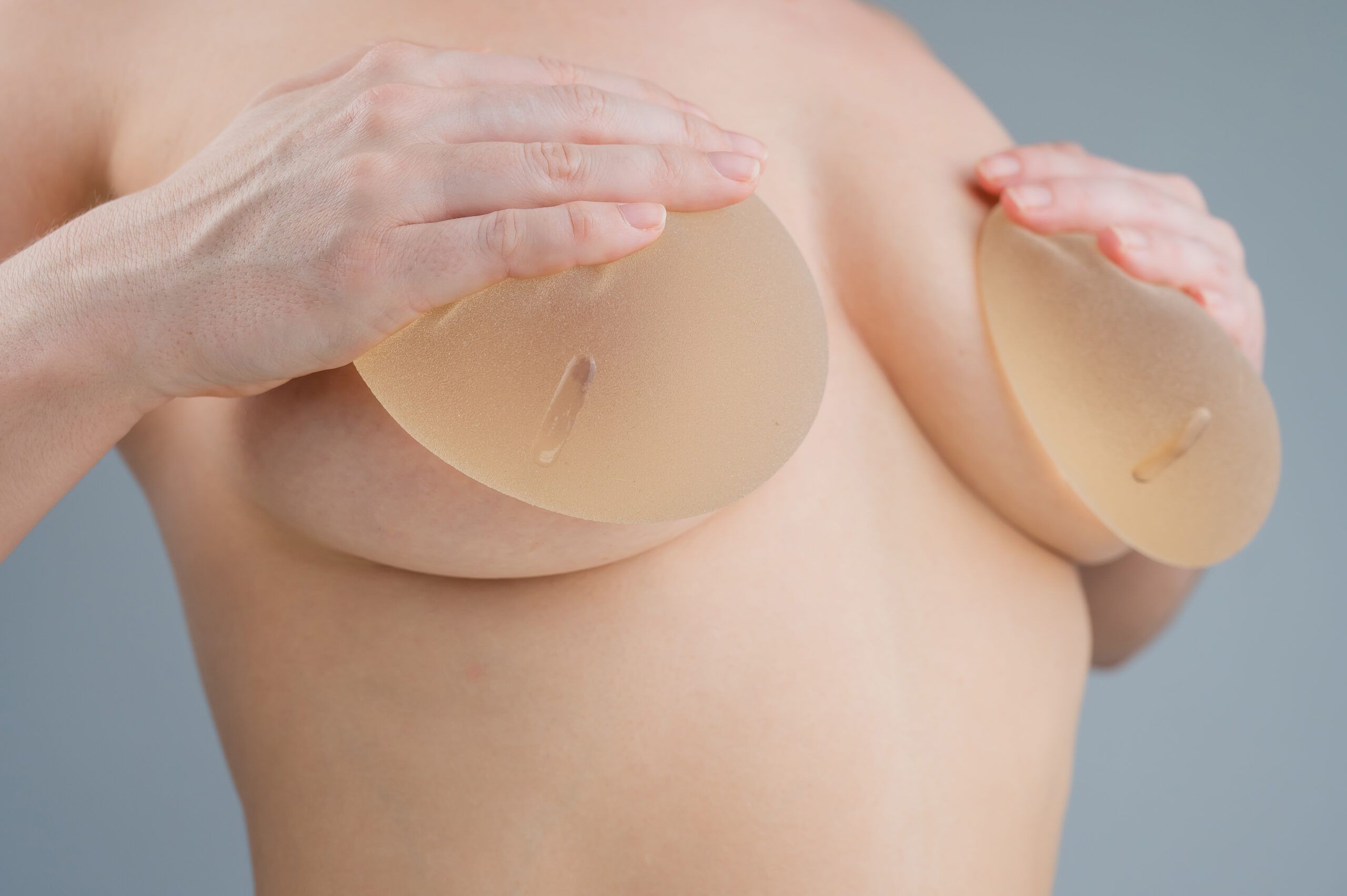
Once a decision has been made about breast implant width and projection, a sizing session is performed, placing silicone prostheses in the bra to demonstrate the plan and ensure that patient and surgeon are on the same page with the desired result and plan. The breast implant volume (in cc’s) is somewhat dictated by the decisions that have been made about the width and projection.
2. Implant Type
Beyond size, the style and material of breast implants play a crucial role in achieving a natural result.
Implant style factors
- Round soft gel vs round firm gel vs teardrop shape
- Implant surface texture: macro-textured, micro-textured, nano-textures, smooth
Historically, a more natural result would be achieved by using a teardrop implant and placing under the muscle (or in fact, a dual-plane approach usually). However, there are significant drawbacks to both teardrop implants and dissecting the muscle off the chest wall to make an implant pocket. Since the more recent invention of round but softer gel implants, teardrop implants have largely been replaced in much of European cosmetic and cancer reconstruction breast surgery practice. Furthermore, as these implants are softer and more natural in how they conform to the patient’s chest wall, there has been a move away from under the muscle placement across most of Europe in both cosmetic surgery and even in mastectomy and implant reconstruction practice. There are certainly still occasions where under the muscle implant placement is the better option and so this requires discussion and a customised decision to be made with the patient in clinic with a thorough discussion about the risk profiles of both options.
3. Choosing the right breast augmentation surgeon for a natural result
No two patients are the same, which is why personalised breast augmentation planning is essential. Prior to committing to a consultation with a surgeon, make sure that you are satisfied with the following:
- Are they a qualified surgeon in the UK?
- This sounds very basic but double check that the surgeon is a fellow of the royal college of surgery (FRCS after their name).
- Do they specialise in breast augmentation surgery?
- There are many “qualified” surgeons in the UK who just don’t do enough of a specific procedure to be an expert. For a breast augmentation operation, on paper your surgeon needs to be either a “specialist consultant breast surgeon” with oncoplastic training or a consultant plastic surgeon. However, many specialist breast surgeons only really perform a high volume of cancer surgery and very little purely cosmetic work, as much as they are solely specialised in breast operating. Similarly, many consultant plastic surgeons perform very little breast surgery, with their practice mainly concentrated on a different part of human anatomy (e.g. predominantly a hand surgeon).
- Do they perform a high volume of breast implant procedures?
- Don’t be afraid to ask your surgeon direct questions about their expertise and experience!
- Do they achieve the type of result that you want to achieve?
- No surgeon can guarantee you the result that you want to achieve (and I’d advise to be wary of any surgeon that does!) However, most surgeons will have some before and after photos published somewhere (in my case, mainly Instagram). Different patients communicate a different desired result so don’t expect every bore and after to resonate with the result you want to achieve, but ensure that there are some photos that you can relate to and results with which you would be happy!
- Do their previous patients appear to be satisfied with the results?
- Seek out patient reviews! Personal recommendations are powerful and meaningful. Surgeons often have accounts on independent websites such as Doctify, TopDoctors and of course Google Business where patients can (often anonymously) provide reviews and feedback. There are also multiple social media groups (often Facebook groups) that are geared towards specific procedures. These can be a useful source of information.
Finally: A surgeon that you “click” with
Arguably the most important factor in choosing a surgeon is making sure that you feel that you are on the same page and working towards the same goal. There needs to be a two way trust relationship when finding a surgeon to perform your breast augmentation procedure. Many surgeons will offer a free telephone consultation to chat through things, really just to establish whether you feel comfortable with their attitude towards your surgery and ask any general questions you might have that would help you to decide whether you feel that they are right for you and your desired result.