
Abdominoplasty (Tummy Tuck)
Our expert abdominoplasty service helps flatten and reshape the abdomen by removing excess skin and fat, tightening the underlying muscles and restoring a smoother, firmer contour that feels more in line with how you want to look and feel in your clothes and in yourself.
Mr Andrew Pieri and his team offers carefully planned tummy tuck surgery to address loose skin, stubborn fat and weakened abdominal muscles, often following weight loss or pregnancy. Combining meticulous surgical technique with an individualised approach, he tailors each abdominoplasty to your body shape, skin quality and goals, aiming for a natural, balanced result and a more comfortable, confident you.
What is Abdominoplasty?
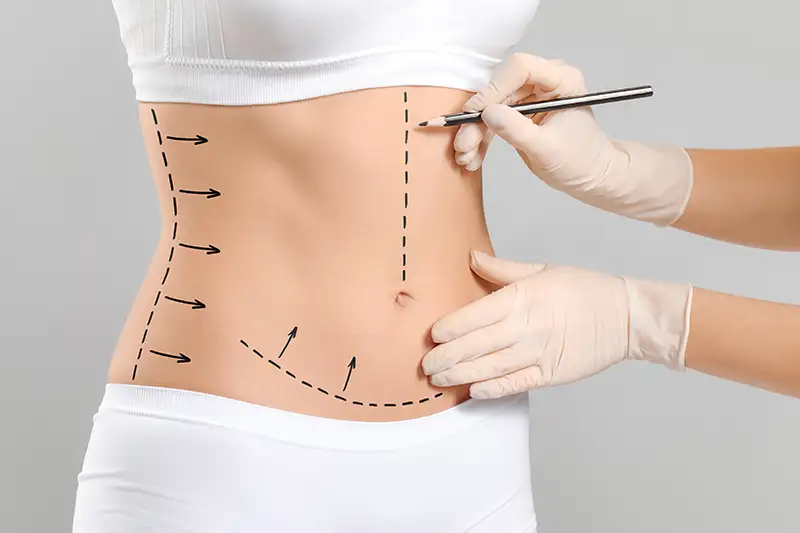
Abdominoplasty, commonly known as a tummy tuck, is an operation designed to remove excess skin and fat from the lower abdomen while tightening the underlying muscles. This can improve the appearance of a “bulge” or apron of tissue, redefine the waistline and restore a smoother, firmer profile that clothing sits better over.
The procedure is usually performed under a general anaesthetic. A curved incision is placed low across the abdomen, typically hidden within underwear or swimwear, and in many cases the abdominal muscles are tightened to address separation (rectus diastasis). The remaining skin is then redraped and the belly button is positioned in a natural location. Scarring is permanent but usually fades significantly over time, and careful planning aims to keep it as discreet as possible.
Abdominoplasty can be particularly helpful after pregnancies or major weight loss, where skin laxity and muscle weakness cannot be improved with diet or exercise alone. The goal is not weight loss, but refinement of contour and proportion, helping you feel more comfortable in fitted clothing and more at ease with your shape.
PRICE GUIDE
What to Expect from Abdominoplasty Surgery
Consultation & Preparation
-
Assessment & Planning:
Mr Andrew Pieri will take a detailed medical history, examine your abdominal skin, fat distribution and muscle tone, and discuss what you hope to achieve. Clinical photographs and careful measurements assist in planning incision placement, muscle tightening and the extent of skin removal, as well as setting realistic expectations about scarring and contour. -
Pre-operative Guidelines:
You will be advised to avoid certain medications, such as aspirin or anti-inflammatory drugs, that may increase bleeding risk. You should stop smoking well in advance and limit alcohol intake, as both can affect wound healing. Because abdominoplasty is usually performed under general anaesthetic, you will need to fast from midnight before surgery and follow specific instructions on regular medications. -
Practical Arrangements:
You should arrange for someone to collect you and stay with you for at least the first 24 hours. Prepare loose, high-waisted, front-opening clothing that will not rub on the incision, and consider arranging help with heavier household tasks and childcare while you recover.
Surgery & Immediate Aftercare
-
Anaesthesia & Procedure:
Abdominoplasty is carried out under a general anaesthetic and typically takes 2–3 hours, depending on complexity. A low, curved incision is made across the lower abdomen, and, where necessary, an additional small incision is made around the belly button. Excess skin and fat are removed, the abdominal muscles may be tightened with sutures, and the remaining skin is pulled gently down and secured. Fine stitches and dissolvable sutures are used to close the wounds. In some cases, small drains may be placed to remove fluid and are usually removed within a day or two. -
Dressings & Support:
You will wake up wearing dressings and a supportive compression garment around your abdomen. This garment helps to reduce swelling, support the repaired muscles and improve comfort. Mild to moderate discomfort, tightness and a feeling of pulling are normal; these are usually well managed with prescribed pain relief.
Recovery, Results & Follow‑Up
-
Early Recovery (Weeks 1–2):
You will be encouraged to walk gently as soon as possible to reduce the risk of blood clots, but you should avoid standing completely upright for the first few days to protect the wound. Keep your abdomen supported and follow advice on showering and dressing changes. Swelling and bruising are common and gradually settle over the following weeks. -
Resuming Activities:
Most patients return to desk-based work after 2–3 weeks, depending on the extent of the surgery and the nature of their job. Heavy lifting, strenuous exercise and core-focused workouts should be avoided for at least 6 weeks. Driving should only resume once you are comfortable, mobile and no longer taking strong pain medications. -
Healing & Outcome:
It may take several weeks to months for swelling to fully settle and your final abdominal contour to emerge. The scar will initially be red or pink, gradually fading over 12–18 months. Scar care and massage, as advised by the team, can help optimise the final result. -
Follow-Up Appointments:
You will be reviewed at around 1 week, 2 weeks and 3–6 months post-operatively to monitor healing, remove any external sutures if required and answer questions. Further appointments are arranged as needed to ensure you are healing well and satisfied with your outcome.
Enquire about this procedure
Please note that while you’re on Mr Andrew Pieri’s official website—where he oversees standards and reviews every enquiry—certain procedures are carried out by his highly trained surgical team. When you submit your details below, your enquiry will be directed to the appropriate team member, who will contact you promptly to discuss your needs and arrange your consultation. Rest assured that Mr Pieri personally monitors all enquiries to ensure you receive the same exceptional care and expertise for which his practice is known.